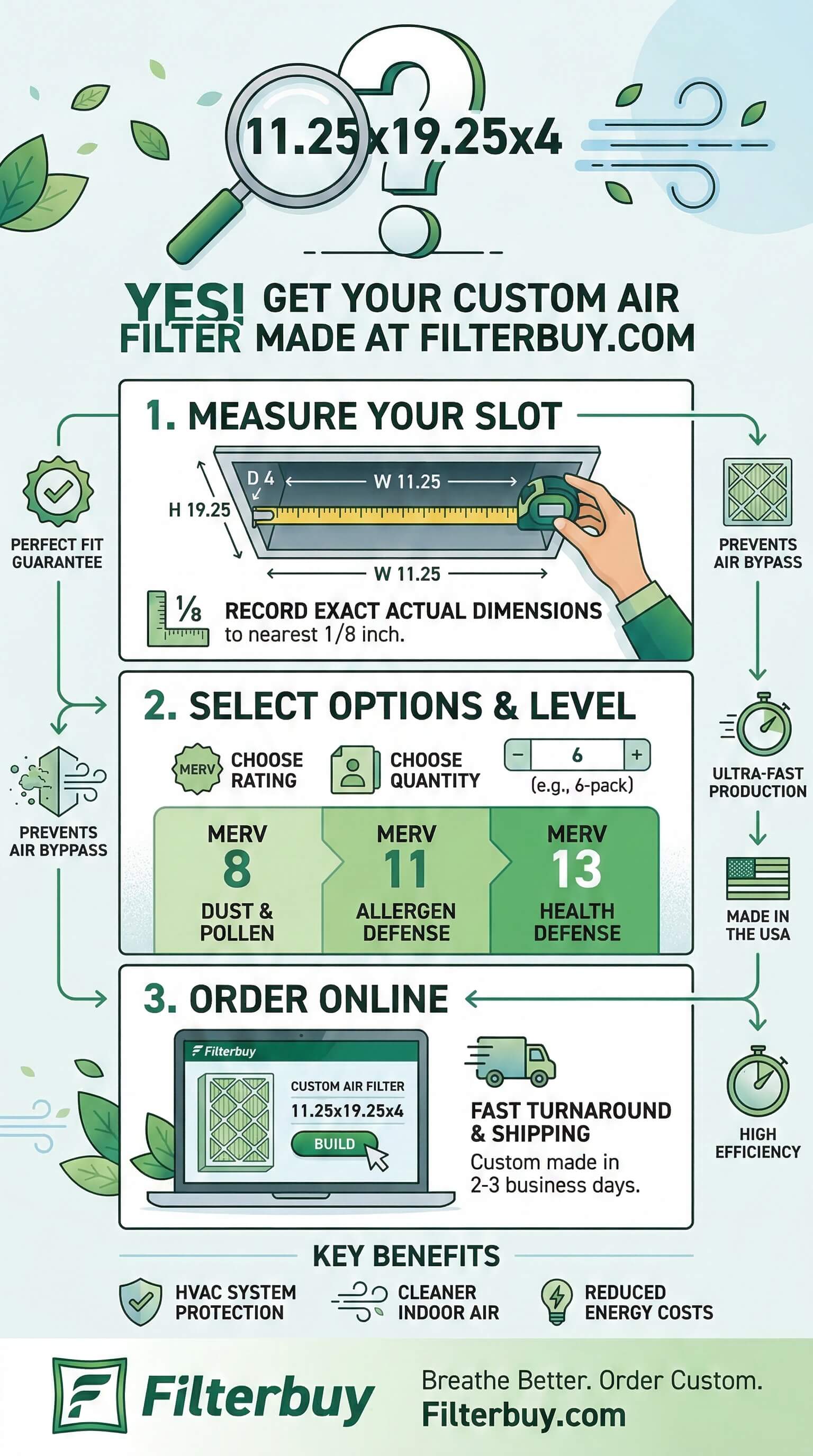
We cut this filter every week. The 11.25x19.25x4 isn't a specialty order or a size you have to hunt for — it's a standard production run on our manufacturing floor, available in MERV 8, 11, and 13, and shipping to your door faster than a hardware store trip would solve the problem anyway.
Homeowners land on this page after striking out at Home Depot, scrolling through Amazon listings that look close but aren't exact, and wondering whether their system needs something unusual. It doesn't. What feels like an odd size is simply an actual-measurement filter — the real dimensions of your housing slot, not a rounded nominal approximation. We've manufactured filters across more than 600 sizes, and the ones that trip people up at retail are often the ones ordered most frequently through us.
The 4-inch depth is where this filter earns its keep. Four inches of media holds significantly more particulate before it needs changing, runs longer between replacements, and handles higher MERV ratings without choking airflow. That last part matters more than most homeowners realize — a MERV 13 in a 1-inch filter will strain most residential systems; the same MERV 13 in a 4-inch filter typically won't.
For a grounding on what air filters do at the mechanical level, the air filter overview on Wikipedia is worth two minutes. We obsess over the details that reference skips — exact sizing, MERV selection, and replacement timing that actually protect your system and your family.
Shop the full 11.25x19.25x4 selection: filterbuy.com/air-filters/11-25x19-25x4/
TL;DR Quick Answers
11.25x19.25x4 Air Filters
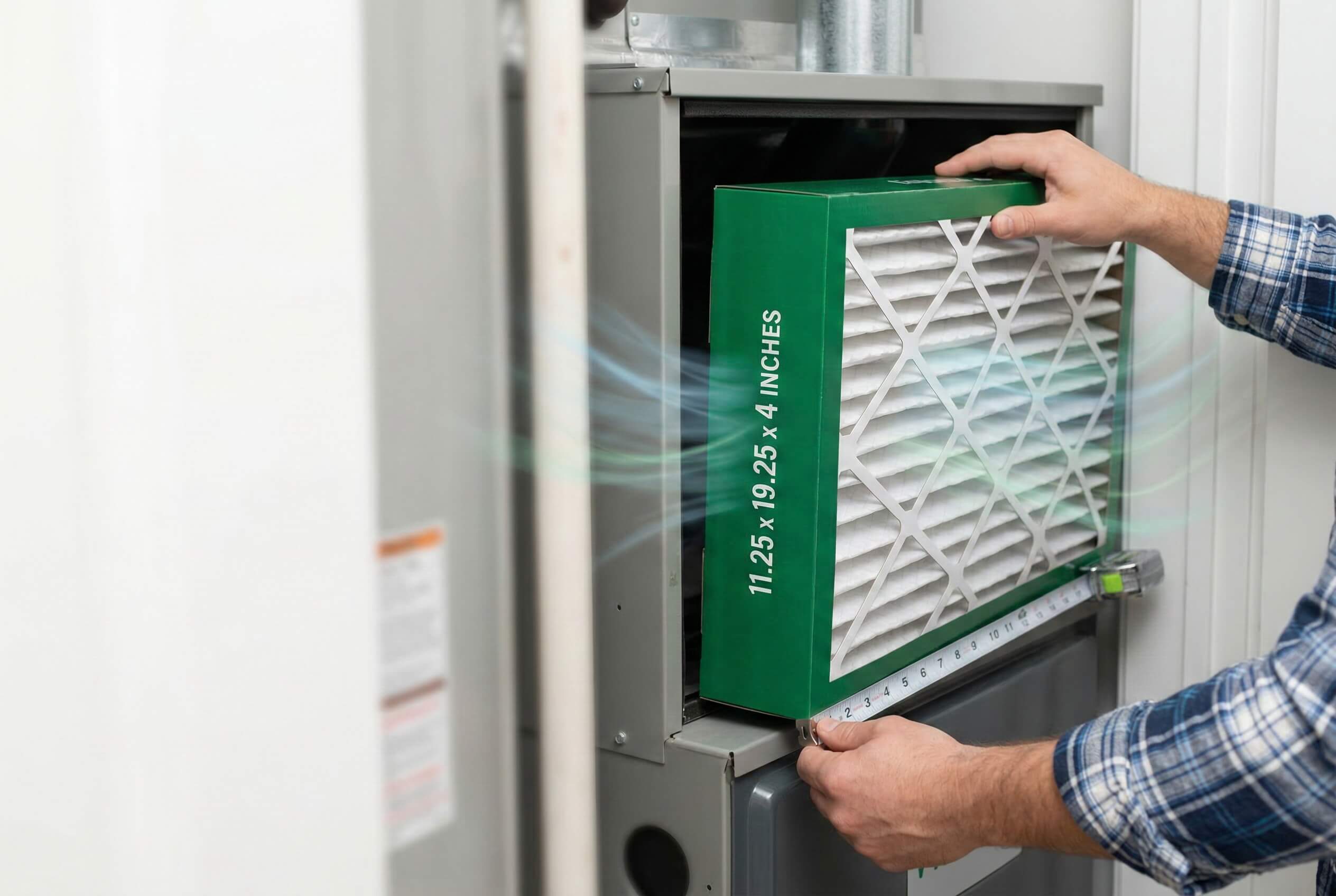
An 11.25x19.25x4 air filter measures 11.25 inches wide, 19.25 inches tall, and 4 inches deep. These are actual dimensions — not nominal — so the filter fits your housing slot exactly as measured.
Key facts at a glance:
• Filter type: Pleated HVAC/furnace air filter, 4-inch depth.
• Available MERV ratings: MERV 8, MERV 11, and MERV 13.
• Replacement frequency: Every 6 to 12 months (versus 1 to 3 months for 1-inch filters).
• Best for MERV 8: Standard households without pets or allergy concerns.
• Best for MERV 13: Allergy, asthma, or multi-pet households.
• Where to buy: Direct from a filter manufacturer — this size falls outside most retail store inventories.
• Installation time: About 3 minutes; arrow on frame points toward the blower motor.
Why the 4-inch depth matters: After manufacturing millions of filters, we've found that 4-inch media holds four times more surface area than a 1-inch filter. That means finer particles get captured, airflow stays strong, and the filter lasts significantly longer between changes — all without straining your HVAC system.
Top Takeaways
• Fit is non-negotiable. The 11.25x19.25x4 is an actual-measurement size — not nominal. A close substitute creates bypass gaps. Order the exact size.
• Four inches changes the math. Expect 6 to 12 months per filter versus 1 to 3 months for a 1-inch, with stronger filtration throughout that window.
• MERV 8 for most homes, MERV 13 for allergy and pet households. The 4-inch depth makes MERV 13 practical here in a way it isn't with thinner filters.
• Buy the case. Four to six filters cover one to two years. Per-filter cost drops, and you won't run your system unprotected between reorders.
• Retail won't have this size. Home Depot, Walmart, and Amazon rarely stock the 11.25x19.25x4. Order directly from a manufacturer for the exact dimensions.
• A dirty filter costs money. Restricted airflow drives up energy use and wears out HVAC equipment faster. Replace on schedule.
• Write the date on the frame. Arrow toward the blower motor, date in permanent marker. Three minutes and you're done for 6 to 12 months.
Is the 11.25x19.25x4 a Standard or Custom Air Filter Size?
We get this question constantly, and the answer catches people off guard: no, it's not custom. The 11.25x19.25x4 is an actual-measurement size, meaning it reflects the filter's true dimensions rather than a nominal approximation rounded to the nearest inch. Nominal sizes are always slightly smaller than labeled — the 20x25x1 on the shelf is actually closer to 19.75x24.75x0.75. Actual-measurement filters like this one call out exactly what you're getting.
We stock it because we manufacture it, on the same production floor where we cut hundreds of sizes every day. After more than a decade of doing this, we've learned that a filter that doesn't sit flush in its housing slot — even one that's off by a quarter inch — creates a bypass gap where unfiltered air skips the media and heads straight into your system. That gap is invisible. The damage it causes, over months of operation, is not.
MERV 8 vs. MERV 13: Which Rating Does Your Household Need?
Pick the wrong MERV rating, and you've either under-protected your air or, in some cases, restricted airflow enough to make your system work harder than it should. Here's how we think about the three tiers for this size:
• MERV 8: Handles dust, pollen, mold spores, and lint reliably. The right call for homes without pets, smokers, or allergy-sensitive family members. Airflow stays strong, and system strain stays low.
• MERV 11: Where we'd start for a household with one or two pets or mild seasonal allergies. Catches finer particles, including pet dander, that MERV 8 passes through.
• MERV 13: Our recommendation for allergy or asthma households, homes with multiple pets, or anyone who's noticed that indoor air quality affects how the family feels day to day. Captures fine particulate matter (PM2.5), smoke particles, and most bacteria.
The 4-inch depth makes MERV 13 viable here in a way it simply isn't with 1-inch filters. More media depth means more surface area — and more surface area lets the filter do serious filtration work without the pressure drop that pushes a residential blower past its limits. Homeowners who've switched from a 1-inch MERV 8 to this filter at MERV 13 tell us it's one of the more noticeable changes they've made to their home.
Where to Find an 11.25x19.25x4 Air Filter
Home Depot, Walmart, and local hardware stores stock nominal sizes in the most common 1-inch formats. This size isn't among them. The risk of grabbing the closest approximate isn't just about wasted money on the wrong filter — a gap between the filter and the housing frame lets unfiltered air bypass the media entirely, defeating the purpose of the filter while still registering on your thermostat as 'filter installed.'
Ordering directly from a manufacturer solves the fit problem for good. You get the exact 11.25x19.25x4 dimensions, your chosen MERV rating, and the option to buy in a case of 4 or 6 at a lower per-filter cost. One order, set for a year or two.
How to Install an 11.25x19.25x4 Air Filter
Three minutes, start to finish. Here's the sequence:
1. Turn off the HVAC system before you open the filter housing.
2. Find the filter slot — typically inside the air handler cabinet or behind the return air vent grille.
3. Pull the old filter out and check the airflow direction arrow printed on the frame.
4. Slide the new filter in with the arrow pointing toward the blower motor, not toward the return duct.
5. Close the housing and run your hand along the frame edges. There shouldn't be any gap or flex.
6. Restore power. Write today's date on the filter frame with a permanent marker.
That last step sounds small, but it matters. A 4-inch filter runs 6 to 12 months before it needs replacing — and without a written date, most homeowners either change it too early or forget it exists until the system starts laboring. Write the date.
"We've watched this pattern play out across thousands of service interactions: homeowners running 4-inch filter systems who step up from MERV 8 to MERV 13 consistently report the most meaningful air quality improvement — more so than any other single change they make to their HVAC setup. The geometry is the reason. A 4-inch filter carries roughly four times the media surface area of a 1-inch filter, and that surface area is what lets it filter efficiently without creating the pressure drop that strains a residential blower. The 11.25x19.25x4 is a size that rewards getting it right. Precise fit. Correct MERV for the household. Consistent replacement schedule. When those three things line up, the filter does its job invisibly — which is exactly how it should work."
— Filterbuy Air Quality and Manufacturing Team
7 Essential Resources on Air Filtration and Indoor Air Quality
Every source we cite is a .gov or .org domain. No aggregators, no secondary coverage. These seven resources are the ones we return to ourselves when a claim needs checking or a homeowner asks us to back up a recommendation.
1. EPA — Guide to Air Cleaners in the Home
epa.gov/indoor-air-quality-iaq/guide-air-cleaners-home
The EPA's consumer guide to HVAC filters and portable air cleaners — MERV rating ranges, how to pick the right filter, how often to change it, and why fit matters. If a homeowner reads one reference before buying a filter, this is the one we'd hand them.
2. EPA — What Is a MERV Rating?
epa.gov/indoor-air-quality-iaq/what-merv-rating
A plain-language explanation of how MERV ratings are derived and which particle sizes each level targets. Short and direct — read this before choosing between MERV 8, 11, and 13.
3. ASHRAE — Residential Filtration Technical FAQ
ashrae.org — Residential Filtration FAQ (PDF)
ASHRAE wrote the MERV standard. This FAQ explains why most HVAC systems ship with MERV 1–4 filters — the short version is cost and airflow, not performance — and what to think through before upgrading to a higher rating.
4. ENERGY STAR — Heat and Cool Efficiently
energystar.gov/saveathome/heating-cooling
ENERGY STAR's maintenance guide covers the direct link between a dirty filter and higher energy bills. We've seen this play out on service calls across thousands of homes. The relationship between filter condition and system efficiency is real and it shows up on the utility statement.
5. CDC — Steps for Cleaner Air at Home
cdc.gov/respiratory-viruses/prevention/air-quality.html
The CDC's residential air quality guidance — pleated filters, replacement schedules, and running the system fan consistently. Worth reading for any household, not just those with respiratory concerns.
6. NIEHS — Indoor Air Quality and Health Effects
niehs.nih.gov/health/topics/agents/indoor-air
The National Institute of Environmental Health Sciences tracks the long-term health research on indoor air pollutants. The case for consistent filtration isn't just about comfort — it's in the peer-reviewed literature, and NIEHS is where that work lives.
7. AAFA — Steps to Improve Your Home's Indoor Air Quality
community.aafa.org — Indoor Air Quality Steps
The Asthma and Allergy Foundation of America recommends quality HVAC filters as one of four core strategies for reducing indoor allergens. If allergy or asthma management is part of why you're here, start with this resource alongside ours.
3 Supporting Statistics
Three verified figures, each drawn from a .gov or .org source, each connected to what we've actually seen in homes.
Americans spend roughly 90% of their time indoors, and indoor air runs 2 to 5 times more polluted than outdoor air.
Source: EPA — Guide to Air Cleaners in the Home (2nd Ed.), epa.gov
That number reframes what a filter actually is. It's not a maintenance checkbox — it's the primary mechanism protecting the air your family breathes through most of every day. We manufacture with that in mind. Getting the size right, the MERV rating right, and the replacement schedule right isn't optional. It's the whole job.
Heating and cooling account for roughly half of a home's total energy use.
Source: ENERGY STAR — Heat & Cool Efficiently, energystar.gov
A clogged filter makes the system work harder to push air through — and that extra effort shows up directly on the utility bill. We've pulled enough dirty filters to know what 'overdue' looks like. A 4-inch filter on a consistent replacement schedule is one of the most cost-effective maintenance habits a homeowner can build, and ENERGY STAR's data backs that up.
The EPA recommends upgrading to MERV 13 — or the highest rating the system can handle — for fine particle filtration.
Source: EPA — What Kind of Filter Should I Use?, epa.gov
Fine particulate matter (PM2.5) is what the EPA flags as the particle size of greatest health concern — and MERV 13 is the residential threshold for capturing it. The 4-inch depth of the 11.25x19.25x4 is what makes that rating practical here. In a 1-inch filter, MERV 13 creates enough airflow resistance to stress most residential blowers. In a 4-inch, that resistance is distributed across four times the media surface. That's why we carry this size in MERV 13.
Final Thoughts
We've manufactured filters long enough to know that the 11.25x19.25x4 gets misread as a rare or specialty size when it's neither. The confusion comes from retail, not from reality. Big-box stores stock a narrow band of nominal sizes, and this one sits outside it — so homeowners assume the size is unusual when the problem is actually just where they're looking.
The filtration decision that matters most isn't the size. It's the MERV rating and the replacement schedule. A 4-inch filter left in too long does less for your air than a 1-inch MERV 8 changed on time. Filtration is an ongoing system, not a product purchase.
Pick the MERV rating your household actually needs. Buy a full case so you're not scrambling for a reorder in nine months. Write the date on the frame when you install it. That's the complete picture — and it starts with a filter that fits.
Frequently Asked Questions
Q: What are the actual dimensions of an 11.25x19.25x4 air filter?
A: The 11.25x19.25x4 measures exactly 11.25 inches wide, 19.25 inches tall, and 4 inches deep. These are actual dimensions, not nominal — meaning the filter you receive matches those numbers precisely. Measure your housing slot before ordering. A quarter-inch gap around the frame creates a bypass channel where unfiltered air skips the media entirely.
Q: Which MERV rating should I choose for an 11.25x19.25x4 filter?
A: Start with MERV 8 if your household has no pets and no allergy concerns — it handles dust, pollen, mold spores, and lint at low system strain. Move to MERV 11 if you have one or two pets or seasonal allergy symptoms. Go to MERV 13 for allergy or asthma households, smokers, or homes with multiple pets. The 4-inch depth makes MERV 13 airflow-friendly in this size, where it would restrict a 1-inch filter noticeably.
Q: Can I buy 11.25x19.25x4 filters in bulk?
A: Yes, and it's the smarter way to buy. A 4-inch filter runs 6 to 12 months before it needs replacing, so a case of 6 covers most households for one to two years. Bulk pricing reduces the per-filter cost, and having a backup on the shelf means the system never runs unprotected while you wait on a reorder.
Q: Why is the 11.25x19.25x4 hard to find at Home Depot, Walmart, or Amazon?
A: Big-box retailers stock a limited range of nominal sizes — primarily the most common 1-inch formats. The 11.25x19.25x4 is a 4-inch actual-measurement size that falls outside those inventories. When you find something close at a hardware store, the risk is a filter that doesn't sit flush, leaving frame gaps that bypass filtration. Ordering directly from a manufacturer gets you the exact dimensions your housing slot requires.
Q: How often should I replace an 11.25x19.25x4 air filter?
A: Most 4-inch filters last 6 to 12 months. Homes with pets, heavy dust, or allergy-sensitive family members should check the filter every 3 to 6 months and swap it when the media looks visibly loaded. Writing the installation date on the frame makes this easy to track without guesswork. For context, a 1-inch filter in similar conditions needs replacing every 1 to 3 months.
Find Your Filter
Your HVAC system runs year-round — it deserves a filter that fits the slot exactly and matches what your household actually needs.
Shop MERV 8, MERV 11, and MERV 13 options for the 11.25x19.25x4 at Filterbuy.com
Learn more about HVAC Care from one of our HVAC solutions branches…
Filterbuy HVAC Solutions - Miami FL - Air Conditioning Service
1300 S Miami Ave Apt 4806 Miami FL 33130
(305) 306-5027
https://maps.app.goo.gl/Ci1vrL596LhvXKU79